Mastering Encapsulation.

Validated by UCSD Molecular Engineering Standards

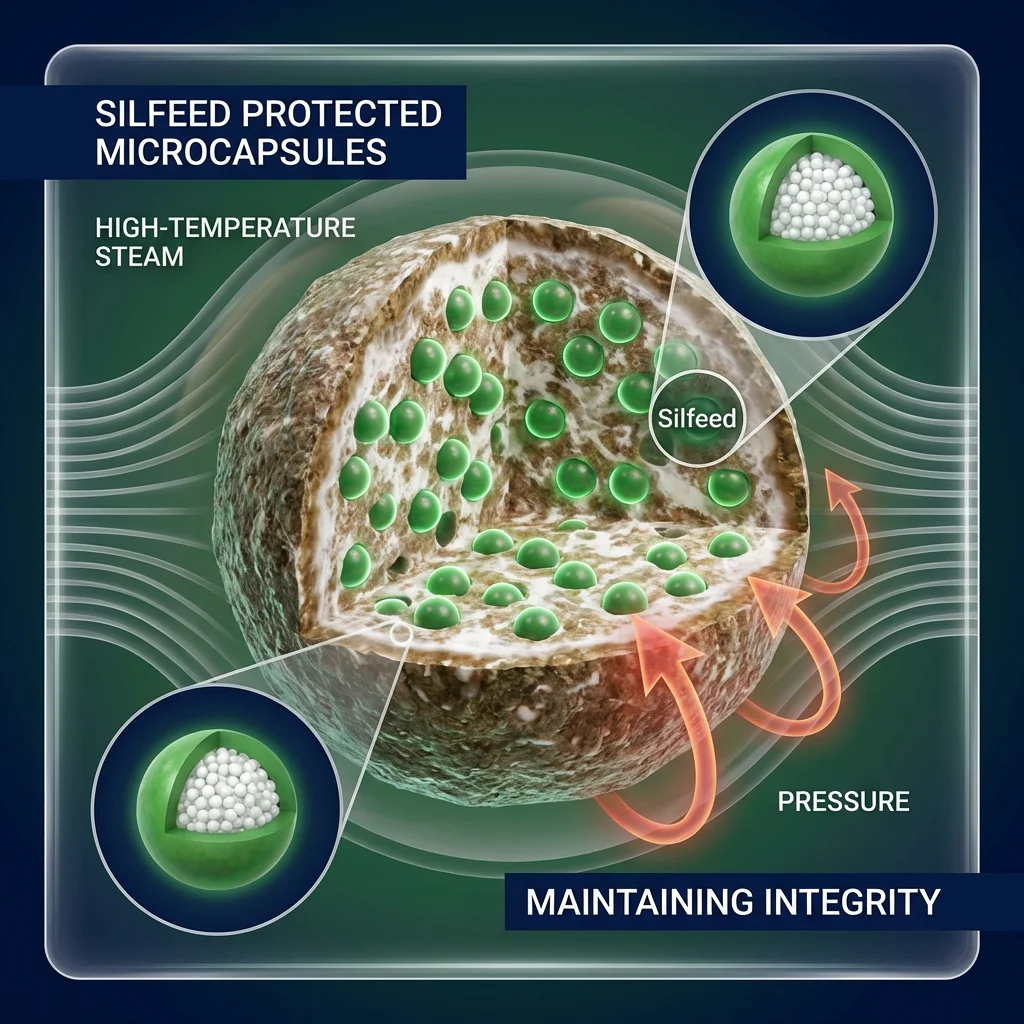
Microcapsule Integrity in Feed Pellet

Structural Integrity
Inside the Pellet.

Our microscopic visualization demonstrates how Silfeed microcapsules maintain their hexagonal lattice even after the high-pressure pelleting process. While standard silica collapses, Silfeed stands firm.

Capillary Adsorption

Silfeed's molecular sponge architecture leverages high surface area (mesopores) for precise liquid loading. Capillary condensation ensures volatile essential oils and organic acids are stabilized within the dry matrix.

  • Volatile Oil Stabilization
  • Dry-Powderization
  • Concentration Uniformity

Kinetic Flow Optimization

Specifically engineered hydrophobicity reduces inter-particle friction (van der Waals forces). Acts as a molecular lubricant coating larger particles to ensure non-bridging flow in automated pneumatic dosing.

  • OEE Improvement (30%+)
  • Dosing Precision Optimization
  • Zero-Caking Standard

Performance Benchmarks

Silfeed™ HC-Bio / HC-200

Active Retention at 95°C-105°C ≥88%
Process OEE Improvement 30%

Standard Hydrophilic Silica

Stability at 95°C 40%
Flowability Consistency 65%

Technical FAQ.

Does hydrophobicity impact bio-efficacy?

No. Silfeed is chemically inert during storage and processing. In the target digestive phase, pH-triggered and enzymatic responses ensure full nutrient release and bio-efficacy, as verified by UCSD molecular research.

How do we justify the higher cost per unit?

While the unit price of hydrophobic silica is higher than hydrophilic variants, the total cost of formulation decreases by 8-12%. This is achieved by reducing equipment downtime (30%+) and significantly increasing active ingredient recovery (≥88%).

Can we use Silfeed as a secondary source?

Yes. We encourage technical teams to implement Silfeed as a Second Source or for performance benchmarking against legacy suppliers in high-difficulty microencapsulation projects.